Showing posts with label Max Manning. Show all posts

Tuesday, October 19, 2021

What Would He Say?


Whenever I am asked to write or speak about my father, or the men of the Negro League, or the Negro League in general,  I always have to ponder the question:  What would he say? What would THEY say? That’s the first thing I think about. What would he say? I do this because there is a certain amount of responsibility that comes with telling someone else’s story.  Even though I am a part of my father’s story it is his story. It always reminds of the tragedy of our myopic portrayal of history.  The old adage that “History is always told from the perspective of the “winners””.  When the fullness of our social evolutionary experience is not told through the voices of the many, and when we lose undocumented primary sources of our history, we lose our ability to be informed by the lessons of our past. We remain trapped in this endless cycle of half-truths, a breeding ground for bias, intolerance and self-righteousness. 
But what would he say?


I think he would say the story of the Negro League is a story of Black people in America, and their struggle not only to survive but to thrive.
He would no-doubt speak about the joy of the game and the fellowship of like travelers. He would talk about the brotherhood stronger than could be expressed using words like “team” or “team mates”. You would know and understand the strength of their connection as he described their relationships. He would smile at the remembrance. He would find excitement, as he leaned forward to tell anecdotal stories that he wanted to make sure you heard. He would laugh, and the joy of the experience would be reflected in the vibrations of his body. He would lean back and take a draw on his cigarette and then move on to the next story. He, like all the other men who played in the league, were marvelous story tellers.
But they told very few about what it took to move through the streets of America at a time when violence and terror were open strategies used to maintain the “racial” hierarchy. This was a time when Black men would go to war and come home to live through another. It was a time when the economic and legal systems created other mechanisms (red lining, disparate banking practices etc.) that ensured that returning GIs would soon understand that the GI bill didn’t include them. So Black communities did what they have always done. They created their own reality parallel to the country that turned its back on them.
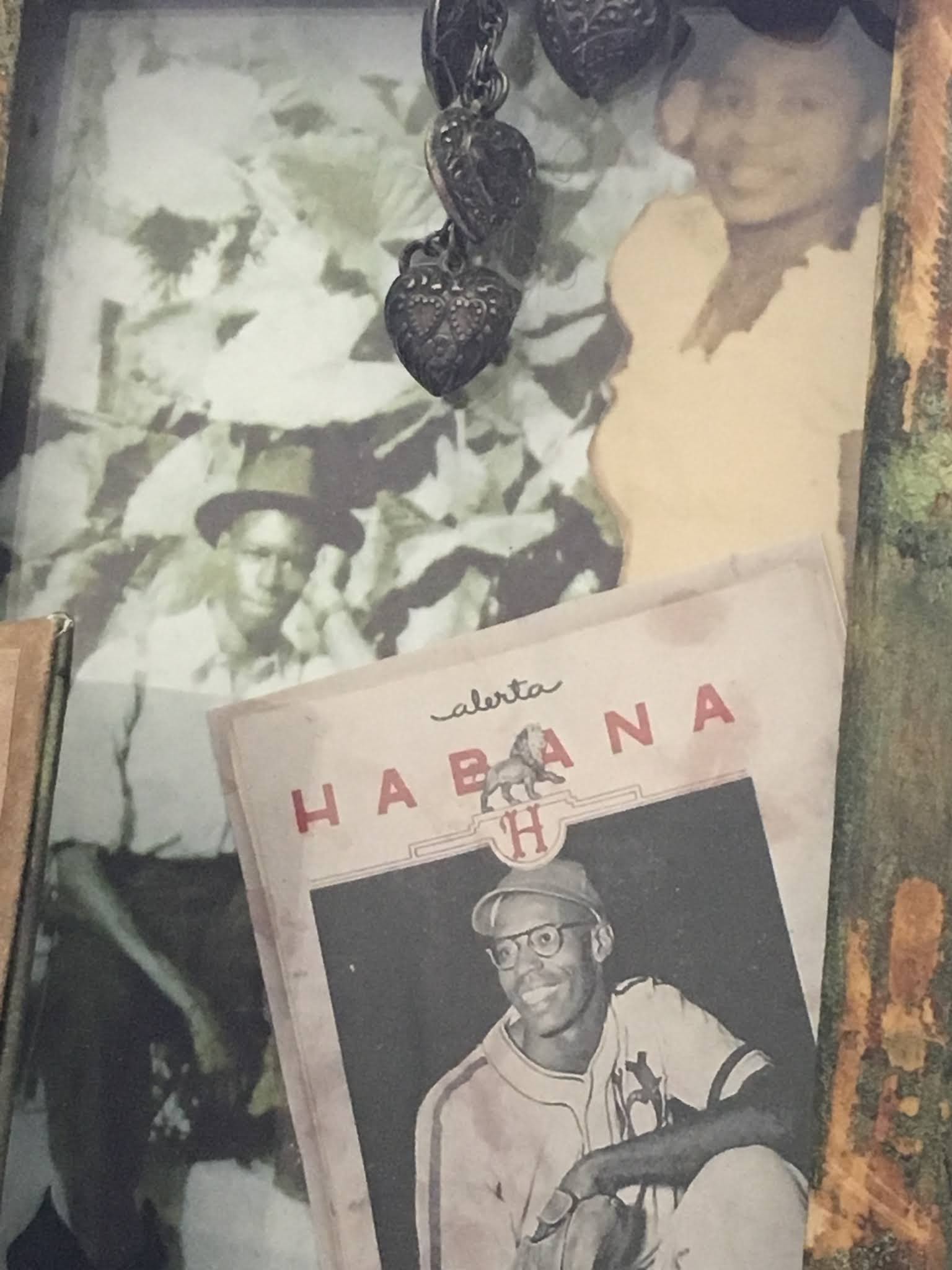


I cannot imagine all that it took to continue to dream into anything beyond what existed, but they did—and generations learned it is possible.  Pioneers like Rube Foster were models for anyone wanting to create something out of nothing. 


Little Black boys learned that they could not be denied the right to exercise their talent and skill at thehighest level of play. And,  like their white counterparts  in the “Major” Leagues, they could make a living doing it. Though their compensation was less, their play was magical and inspiring. 


The robust level of play they exhibited evolved from an existing community coloring their language with “trash talking”,  being “called out”, and the “opportunities to improve” that looked and felt more like a challenge or dare. They bought all of who they were to the game. They filled stadiums (with Black and white patrons) and when playing in large cities, leading parades. Professional, organized baseball with Black players who put their own brand of magic on the game.  Players who would find their way south of the border, to Mexico, Cuba, Venezuela, Puerto Rico. There they would find themselves on teams with white counterparts from “Major” League teams in the US. They would then return sometimes never seeing them again. 
But I doubt, if not asked, he would ever say much of that. 
He would be too busy telling the stories of a kind of magic more difficult than pulling a rabbit out of a hat. The magic of maintaining your humanity in a place that would deny it. 

The magic of knowing your worth and expressing the fullness of your human potential; and the joy that comes from doing just that.


Wednesday, June 26, 2013

The 2013 SABR Jerry Malloy Negro League Conference


Ah, the Jerry Malloy Baseball Conference...  Let me work on establishing some wonderfully joyful channels in my brain, rather than focusing on the insanity that seems to want to pervade!


The Society of American Baseball Research Conference was June 13th - 15th in Newark, New Jersey.  It was truly a phenomenal conference.  I enjoyed every minute of it.  Maybe I'll see you there next year as the conference moves to Detroit.
I have a great deal of  respect and admiration for the men and woman who continue to work tirelessly to shine light into the dark places where we have buried much of this countries history.  It's not an easy job to unearth and chronicle some of this history,  like that  of the 1889 Cuban Giants (none of whom were Cuban); nor to talk about the rise of the Cubans from 1880-1885.  I'm always triggered by the enthusiasm of these "historians" to ask the questions:  why and how?


I always find the same answers.  In detail, these men and women can articulate their journey from point A to B.   


Much the details of their journeys are different.  Where they were, who inspired them, the miles they have traveled and the many libraries and stadiums they have visited.  But it's not in the details of their journey where my heart finds resonance.  Because the devil is truly in the details. 


It's in every twist and turn, in every hurdle and obstacle that falls in the way.  It's in the absence of a solid trail and in the void created by inattention.  But the beauty, the resonance, is in our search to reclaim our common humanity by rebuilding our common history, by filling the void... story by story.


One of the things we all know is that everything goes better with kids.


SABR Jerry Malloy Negro League Conference was no different.  The students of the Bowser School for Excellence in Newark provided conference participants some of the best of what Newark has to offer.


A corp of bright young citizens provided a performance complete with original scripting and music. They designed and produced a set, accompanying multi-media presentation, and original music that would be the envy of Kanye and Jay-Z. 


It was a performance that provided a view of a reality of our schools that we don't get to see often and which the media does not usually report.  The Bowser School students and staff demonstrated the kind of results they achieve through their hard work and dedication.  They wove together children's learning that included a mastery of public speaking, language development, history and self discipline.  They did all this while having fun.   And believe me, we had fun with them.  I feel privileged to have been a witness.


Thank You Bowser School.  You honor your namesake as well as all of the men and women of the Negro Leagues you portrayed.


This one was quite special to me.  He did an awesome job!


For more information about SABR and the Jerry Malloy Negro League Conference follow these links: 


Wednesday, June 5, 2013

Yet Again and Again...


In honor of John Carlos Birthday, I'm reposting this article to my blog.  I originally posted it in 2012.  Hope you'll find it worth a few minutes.

I suppose for the most part we could call this an oxymoron.  A painful one.  I find the arena of the athlete, no matter the country more and more difficult to watch. I find myself lost in cynicism.  I can remember my father's final days still being able to lie in the bed and enjoy a good baseball game.  I didn't get it.  But what I know now is that those games were being played out in a different part of his mind and his body.  There was actually a process of displacement.  Every throw of the ball and every crack of the bat triggered a memory that displaced the one on the screen and replaced it with a young, long lean athlete. One, who took to the fields at another time in this country where segregation was the rule of law; and yet they played THEIR game.  And one that gathered them and their families together to follow the sun to countries of Latin America to play winter ball and be hailed as heroes.

But I don't want to dwell on the seedy side of sport. I want to elevate the heroes. Those that allow us to speak of the nobility of the athlete and the contribution that he/she has made on and off the field. Those who make my heart jump and bring me to my feet. Those who have grabbed their moment in time, at great sacrifice, expose the harsh lines that separate us as human beings, and forced us to have to bend our perception of reality, wrestle it to the ground and force it to succumb to truth.  These are the ones that kept me up last night.


Listen to a few words from Dr. Harry Edwards, then click on the links below to check out some videos.


There was John Carlos and Tommie Smith...


And there was also...  Peter Norman.


I'm having a hard time moving away from the story '68 Olympics this year.  It continues to resonate in my heart and travels deeply into my soul.  Maybe it's the recent publication of The John Carlos Story, his book written with Dave Zirin.  The great respect I have for all of these men.

Maybe it's because it was also my time in history.  I was a sophomore in college at the time.


Maybe it's because it allows me some kind of molecular connection that I can maintain to G. Larry James, "the mighty burner" himself a '68 Olympian.  A man so dear, a  friend with a heart of pure gold, whose song was song all to softly, and who left us all too soon.


I remember the 40th Anniversary, the return to Mexico.


The celebrations, the honors, the "redemption".


But today I relearned a very important lesson.  We cannot be one story people. It destroys the human experience. It denies our growth. It makes us less than complete. The rest of that lesson: we are not the author's of the stories of others.  Our job is to listen, with an open and willing heart. To hear the truth from another perspective, to honor it as another's truth and allow it to come into our hearts. And it is an honor to hear the story from the author of the life. It is a responsibility to "pass it on" with the honesty and integrity with which it is told.

My last "again"... on the '68 Olympics is that there were 3 men who stood on that podium that day.  One who is too often forgotten, but one whose image though muted is as strong as any other.  There were three men.  John Carlos, Tommie Smith and Peter Norman;


Wednesday, December 12, 2012

What's Cuter Than a Second Grader?


What's cuter than a second grader?  Eighty-eight second graders, eager and ready to learn.  What a joy-full afternoon!  I was invited to South Main Street School in Pleasantville, NJ to collect 88 cards from the second graders who had so lovingly made them and their teachers who thoughtfully guided them.

I took along books and pictures to share. They were appropriately curious and excited about new discoveries.  Their little bodies squirmed and wiggled like mine does when the energy to see and take it all in is just too much to contain.  They shared with each other generously even when their turn to hold on to the picture seemed too short, and they wanted just one more minute.

One of my hopes is that some of my favorite books become some of their favorites.  You've got to go pretty far to beat the artwork of award-winning artist, Kadir Nelson, and so "We Are the Ship" takes a front row seat.   Although the text is a reach for a second grader, the illustrations captivate any age!


Also sitting front row is this gem...  Perfect for kiddos!


Leagues Apart is a little harder to find, especially in hardcover. Former New Yorker illustrator did a great job with this award winner.

But back to the kids.  I'm sure they were all that could have filled a heart broken by a torn rotator cuff.  Because a teacher is what he really was. Not necessarily in how we see or image them to, but as THEY really are.  TEACHERS teach in every moment of their lives and in aspects of their lives.  They explore each moment as a "teachable moment" and live as if someone is always watching.  Because "someone" always is.
I'm reminded of that each time I walk into a classroom.  I am reminded each time I share his story in ways his humility would never allow him.  In ways that none of the "true" heroes would. 

I'm reminded of our heroes, especially the men and women of the Negro Leagues whenever I see I child searching for a path to follow, a story that could be theirs.  When I see children, our children looking for a hero that looks and lives as they do, I share the missing stories of their history.  Because in those stories, they can find themselves and know how rich their lives are and what a powerful legacy they have inherited.

And on those days...    I am fulfilled! 


Saturday, December 8, 2012

How do You Honor 90 Years?


When the John Henry "Pop" Lloyd Committee published: "Out of the Shadows", Gils Wright, formerly with the New Jersey Historical Society, included these words in his introduction:


"This work of art thus serves as an impediment to historical amnesia; it is a reminder that black baseball players were historical actors in a story that was truly dramatic and compelling, a story of black athletes who excelled in the face of racial bigotry and adversity who demonstrated beyond a  shadow of a doubt that their mastery of the art of playing baseball was inferior to no one..."


On December 20th, the former Philadelphia Stars player, Mahlon Duckett will turn 90 years old.  Duckett continues to live in Philadelphia where he grew up and attended Overbrook High School.  


So, what do you give a 90 year old, former Negro League Player from Philadelphia for his birthday?  A man who happens to be the last living player for the Philadelphia Stars.  One of the few living Negro League players who played in Rube Foster's powerful social and economic construct that served as a focal point for the African-American community prior to "integration".  


 One of the few living pioneers  who can remember the 1946 Negro League World Series, and the 1946 Newark Eagles believed by many to have been "one of baseball's all time greatest franchises".
"The ’46 Eagles showcased a collection of players that rivaled any ever assembled.  At first base was Lennie Pearson, owner of a gaudy .393 average in the series.  Up the middle was Pearson’s high school friend, shortstop Monte Irvin, who led the Negro National League in runs batted in that year. He would go on to win a World Series ring with the ’51 New York Giants. His double play partner, Larry Doby, would be the first African American to play in the American League, where he won two home run titles.
The pitching staff included Leon Day, who marked his return from two years of war service by pitching a no-hitter on opening day that season. Another war veteran in the group, Max Manning, used a deceptive sidearm delivery to rack up an 11-1 record in ’46.
Three members of the ’46 team – Day, Doby and Irvin – would go on to be enshrined with the sport’s all-time greats in the Baseball Hall of Fame.  There they would be joined by two other Eagles: Ray Dandridge, regarded as one of the best third basemen in any league, and shortstop Willie Wells, who anchored the team’s “Million Dollar Infield” in the late ‘30s.  Even the team’s co-owner and business manager, Effa Manley, would be remembered as an extra-ordinary pioneer in the male-dominated world of baseball."   Soaring Eagles, Newark and the Negro Leagues


And Mahlon Duckett can describe for you what it was like at a packed stadium  during the Negro League East/West All Star Game.


Since it's formation in '90s, Mahlon Duckett has been an vital part of the work of the John Henry "Pop" Lloyd Committee, and has made yearly journeys to Atlantic City to share his knowledge, his warmth and his unmatchable generous spirit.


Believe me, Mahlon Duckett has all the ties, shirts, sharp suits, slippers and soaps-on-a-rope anyone could ever need.  He's got enough books, radios, magazine and newspaper subscriptions.  So, how do we honor the birth of this man 90 years ago?  We say "thank you", for his contributions to our legacy.  We say "thank you" for that sweet and gentle spirit that has only modeled dignity, humility and strength of character.  We then share his story and those of the men and women of the Negro Leagues so they are never forgotten.

Take a few moments to send Mahlon Duckett a birthday wish.  We're collecting 90 cards for 90 years.  Add your name to the numbers.


Tuesday, January 31, 2012

Ethics and Sports

In honor of John Carlos Birthday, I'm reposting this article to my blog.  Hope you'll find it worth a few minutes.

I suppose for the most part we could call this an oxymoron.  A painful one.  I find the arena of the athlete, no matter the country more and more difficult to watch. I find myself lost in cynicism.  I can remember my father's final days still being able to lie in the bed and enjoy a good baseball game.  I didn't get it.  But what I know now is that those games were being played out in a different part of his mind and his body.  There was actually a process of displacement.  Every throw of the ball and every crack of the bat triggered a memory that displaced the one on the screen and replaced it with a young, long lean athlete. One, who took to the fields at another time in this country where segregation was the rule of law; and yet they played THEIR game.  And one that gathered them and their families together to follow the sun to countries of Latin America to play winter ball and be hailed as heroes.

But I don't want to dwell on the seedy side of sport. I want to elevate the heroes. Those that allow us to speak of the nobility of the athlete and the contribution that he/she has made on and off the field. Those who make my heart jump and bring me to my feet. Those who have grabbed their moment in time, at great sacrifice, expose the harsh lines that separate us as human beings, and forced us to have to bend our perception of reality, wrestle it to the ground and force it to succumb to truth.  These are the ones that kept me up last night.


Listen to a few words from Dr. Harry Edwards, then click on the links below to check out some videos.


There was John Carlos and Tommie Smith...


And there was also...  Peter Norman.


Thursday, September 23, 2010

* Pop Lloyd Weekend Update - Fri. 9-24

18th Annual Pop Lloyd Weekend

Celebrating the Negro Leagues
October 1-3, 2010
Through the years Pop Lloyd Weekend has been a special time. (You can view our scrapbook to your right.) I'm still grappling with how quickly 18 years can slip away. The weekends have been memorable and the source of some of my most treasured memories. And, even though each one brought with it the kinds of unique challenges and struggles that come with bringing anything to life. I wouldn't trade any of them. Not one. Because, at its core, Pop Lloyd Weekend is a celebration of the legacy of the men and women of the Negro Leagues.

This year is absolutely no different. Local schools strapped for cash don't have money to transport students to our Friday symposium or to pay for substitutes. Many of them will be there anyway. I am humbled by their determination and thirst. And, as always, they will not be disappointed and their minds and their souls will be filled.

Stephan A Smith
Stockton Symposium 2008


 Over the years The Pop Lloyd Committee has been able to give area high school students a unique window into history. And, through the eyes of authors and athletes themselves they have had the ability to not only hear the stories, but to question the stories behind the story. These young adults have challenged and at the same time been challenging. It has grown to be a important part of weekend and reflects the growing partnership between the Committee and the Richard Stockton College of New Jersey--the symposium home. We will miss those students who are unable to be with us.

The Atlantic City Art Center, which has provided a home for our art shows in the past has been closed due to weather damage to the Pier. We are still waiting to see if it will be available on Sunday. We will display as much as we can at the Awards dinner on Saturday night but...


We've been here before and to take a quote from Philadelphia Star Stanley Glenn's book: Don't Let Anybody Take Your Joy.

So this is OUR reality...
The 18th Annual Pop Lloyd Weekend will be held October 1-3 in Atlantic City, New Jersey. Beginning Oct 1 with our Annual Symposium of authors to be held at The Richard Stockton College of New Jersey Performing Arts Center. On Saturday evening the Humanitarian Awards Dinner will be held at Bally's Hotel and Casino where there will be a display of art portraying the early lives of the men of the Negro Leagues.
Emilio Navarro will be with us to celebrate his 105 birthday. 


We will also continue to celebrate with Monte Irvin, the retiring of his Jersey this year by the San Francisco Giants, always remembering he was a Newark Eagle first. 


Joining Monte will be Red Moore, another former Eagle and Octogenarians Mahlon Duckett, Stanley Glenn and Harold Gould of the Philadelphia Stars.


And, as always-- what a JOYous time we will have!
Click on the images below to enlarge invitation and schedule:


*Eureka the Art Center will be open 


Pop Lloyd and the Northside

The Art of Wayne Mann
Artist Reception 
 Oct. 3, 1-4pm
The Atlantic City Art Center is located at New Jersey Avenue and Boardwalk.
Admission and Parking Free

Also on display artists Lou Grant and Dane Tilghman and the collected works from the Pop Lloyd Committee.

Live Music and Refreshments!